
Do You Remember Yesterday’s? Chattanooga’s Lost Music Rooms
Buildings keep dates. People keep nights.
For years, the faded red YESTERDAY’S sign on Patten Parkway marked more than the entrance to a downtown bar. It marked a room where Chattanooga gathered after dark—where bands worked long sets, friendships formed between songs, and ordinary Friday nights became the stories people still tell decades later.
Today, the building has a new name and a new purpose. But the memories attached to Yesterday’s did not disappear when the last drink was poured. This is the beginning of an effort to gather them: the bands, the bartenders, the regulars, the flyers, the photographs, the songs, and the nights Chattanooga should not forget.
Before Yesterday’s, there was a hotel
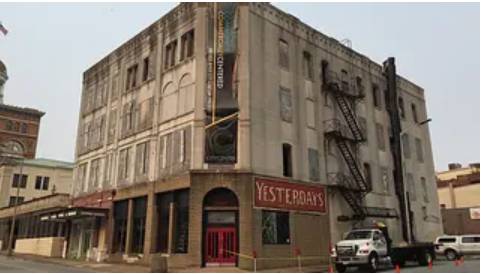
The building at the corner of Patten Parkway carried Chattanooga history long before it carried the Yesterday’s name. According to the National Trust for Historic Preservation, it was built in 1888 as the Delmonico Hotel and reopened in 1925 as the Ross Hotel. The Ross became part of national history when William Jennings Bryan died there after the Scopes Trial in Dayton, Tennessee.
As Chattanooga’s downtown declined in the middle of the twentieth century, the hotel eventually closed. The lower floor found a second life as Yesterday’s—a neighborhood watering hole inside a building that had already lived several lives.
“Everybody of a certain age in Chattanooga has a story about Yesterday’s.”
Stephanie Hays, quoted by the National Trust for Historic Preservation
The bar beneath the old hotel
Yesterday’s was not a polished monument to music history. That is exactly why it matters. It was a working room: a place where performers had to hold a crowd, where audiences could hear familiar songs at full volume, and where the distance between the stage and the people was measured in feet rather than rows of seats.
The National Trust identifies Yesterday’s as the second bar in Chattanooga to serve liquor by the drink. That detail places the room inside a larger change in the city’s nightlife. Chattanooga was becoming a place where a night downtown could mean live music, drinks, dancing, and the possibility of running into nearly anyone.
A working room for working musicians
By the 1980s, Yesterday’s was one of the rooms local listeners associated with hard-working cover bands and long nights. In a recollection published by The Pulse, writer Marc T. Michael remembers that around 1984 bands at places like Yesterday’s played marathon sets. That kind of schedule demanded stamina, range, and the ability to read a room in real time.
A separate personal remembrance of Chattanooga nightlife in the late 1980s describes Friday nights at Yesterday’s listening to cover bands, while nearby Michelangelo’s brought in original regional touring acts. Personal recollections are not the same thing as an official record, but they help reveal an ecosystem: one downtown block could support different rooms, different audiences, and different paths for musicians trying to be heard.
When the after-party walked through the door
Yesterday’s also became known locally as an unofficial after-party destination when major touring bands finished their Chattanooga concerts. These were not scheduled appearances or advertised bookings. They were random, unannounced nights when musicians might walk through the door after their main show and join the crowd.
Community recollections connect members of bands including Cinderella, Bon Jovi, Mötley Crüe, and Warrant with those late-night visits. On occasion, visiting musicians reportedly stepped onto the small Yesterday’s stage and played an impromptu set. There was no guarantee and no advance notice—that unpredictability was part of the magic. An ordinary night could suddenly put arena-level musicians only a few feet from the audience.
Because these moments were informal, much of their history survives through eyewitness memories rather than concert listings. If you were there—or have a photograph, newspaper clipping, flyer, autograph, or a more precise date—your account can help document what happened.
What the official record cannot tell us
Dates and property records can tell us when a building opened, closed, or changed hands. They cannot tell us what song packed the floor, which band drew the biggest crowd, who worked the door, or whose first public performance happened in a corner of that room.
That history lives with the people who were there.
- Which bands do you remember seeing at Yesterday’s?
- Were you a musician, bartender, server, door person, sound technician, or regular?
- What years did you go, and what did the room look and sound like then?
- Do you still have a flyer, photograph, matchbook, menu, ticket, newspaper clipping, or band schedule?
- What other Chattanooga music room deserves to be remembered next?
The building survived. The room did not.
Preservation rarely gives a place back exactly as it was. After decades of decline, the former hotel and Yesterday’s building underwent an approximately $8 million rehabilitation. It reopened as the Tomorrow Building, with 39 apartments and commercial space. River City Company describes it as the first co-living residence in the Southeast.
That outcome saved an 1888 structure that might otherwise have been lost. It also leaves Chattanooga with a familiar tension: we can preserve brick, windows, and a facade, but a music room is made of people, sound, routine, and shared experience. Once the room is gone, its history survives only if somebody tells it.
Yesterday’s was part of a larger scene
Chattanooga’s music history has never belonged to one stage. It stretches from grand rooms like the Tivoli Theatre to neighborhood bars, hotel lounges, clubs, restaurants, record stores, radio stations, school auditoriums, church basements, and borrowed spaces that lasted only a season. Some venues earned plaques. Others survive as a name in an old newspaper advertisement or a story told between friends.
The Choo Choo and Station Street show how historic places can continue to make room for live music in new forms. Songbirds has connected music history, education, and performance. The Tivoli remains an anchor. But the full story of Chattanooga music also depends on the smaller rooms—the ones where local players learned how to work a crowd and listeners discovered who their city sounded like.
Help us rebuild Chattanooga’s musical memory
If you remember Yesterday’s, we want to hear from you. Leave a comment with the year, the band, the people, or the moment you remember. If you have photographs, flyers, newspaper clippings, or memorabilia, send Chattanooga Music Scene a message. Please include any names, dates, credits, and permission information you know. We will correct the record when better information becomes available.
Nothing is too ordinary to matter. The name of a bartender, the color of the walls, the route you drove downtown, the band that played your favorite song—those details are the archive.
Yesterday’s may be gone, but Chattanooga is still here. So are the people who heard the music.